
Posted 9th July 2025
Why Is Asia the Prime Destination for Real Estate Investing in 2025-2026?
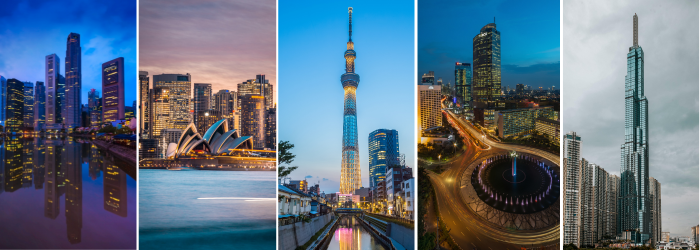
Asia Pacific's (APAC) economic fundamentals, fast-growing cities, and expanding middle class are turning the region into the world's hottest real estate investment zone. According to CBRE's Investor Intentions Survey, over 60% of global investors plan to increase APAC exposure in 2025, drawn by cities like Singapore, Ho Chi Minh City, and Bangalore.
Throughout Asia, investors are increasingly seeking capital allocation opportunities in Asian real estate markets to diversify portfolios and secure long-term yields.
The region's sustained economic growth, coupled with massive infrastructure spending and a resilient consumer base, continues to attract institutional investors. Countries like Vietnam, Indonesia, and India are experiencing GDP growth rates well above the global average, while more mature markets like Australia and Japan offer stability and regulatory transparency that international investors value. With rising disposable incomes and urbanisation rates, the demand for modern office, residential, and retail spaces will only continue to climb.What Real Estate Sectors Are Driving Growth in APAC?
Investors are prioritising logistics (thanks to e-commerce), sustainable commercial properties, and the surging data centre sector. JLL reports that data centre investment alone will reach $15 billion in APAC by 2026. Demand for ESG-aligned office spaces in cities like Tokyo and Seoul is also fueling capital flows.
Firms developing innovative ESG and smart city solutions are also finding fertile ground for partnerships as sustainable investing becomes mainstream across APAC.
Logistics assets remain a key driver of returns as companies seek last-mile distribution centres to meet consumer expectations in Southeast Asia's densely populated cities. Meanwhile, green-certified commercial buildings are attracting both tenants and investors due to stricter sustainability regulations and growing climate awareness among corporate occupiers. Industrial and logistics real estate are benefitting from supply chain diversification strategies as companies reduce overreliance on a single country for manufacturing.Which Investment Strategies Are Winning in APAC?
Savvy investors are deploying private equity funds, REITs, and co-investment structures to balance risk. ESG investing is emerging as a must-have: buildings with green certifications achieve up to 10% rental premium, according to CBRE's 2025 Decarbonisation Report.
Investors are also becoming more selective about which cities and sectors to target, favouring a tiered investment approach that blends core assets in gateway cities with opportunistic acquisitions in emerging urban centres. This approach helps capture growth potential while mitigating risk.Co-investment platforms, where multiple investors join forces to acquire or develop a property, have become more popular in APAC markets with complex regulatory environments. These structures offer local knowledge and operational efficiencies, especially when investing in countries like China, Vietnam, or the Philippines. Meanwhile, REITs in Singapore, Japan, and Australia are evolving to include green assets and technology-enabled properties, attracting a broader base of institutional capital.
Register your interest to visit EXPO REAL Asia Pacific 2026 to connect with key players shaping these markets.
What Are the Key Risks for Investors Entering Asian Markets?Geopolitical tensions, particularly in Northeast Asia, remain top of mind for investors considering long-term strategies. Rising US-China tensions, potential instability in the Korean Peninsula, and maritime disputes in the South China Sea all have the potential to disrupt investor confidence.Diverging interest rates among central banks in APAC can complicate financing strategies, with countries like Japan maintaining ultra-low rates while others like India or Indonesia adjust rates more aggressively in response to inflation. These discrepancies can affect currency stability and returns on foreign-denominated investments.Maturity differences across markets require hyper-local expertise. Investors familiar with markets like Singapore or Sydney may find the regulatory frameworks in emerging economies more challenging, leading to a need for local partners. Yet strong fundamentals and rising urban demand mean APAC continues to offer risk-adjusted returns superior to most global regions.How Will EXPO REAL Asia Pacific 2026 Shape the Investment Landscape?Events like EXPO REAL Asia Pacific 2026 connect global capital with APAC developers, city officials, and infrastructure leaders. These connections can accelerate projects, unlock partnerships, and help investors understand local nuances.
Meanwhile, governments are prioritising urban infrastructure partnerships to future-proof cities and attract global capital.
By attending, you gain direct exposure to institutional capital trends, meet ESG solution providers, and explore Asia's most promising urban development opportunities. The event will also showcase thought leadership sessions, panel discussions with city planners, and networking forums for investors to engage directly with high-level decision-makers.What Should Real Estate Investors Do Next?
For developers aiming to expand in high-growth APAC markets, now is the time to align with rising trends and investor priorities.
To position yourself strategically in APAC's dynamic real estate market, investors and developers should start planning for EXPO REAL Asia Pacific 2026. By understanding key investment themes, assessing potential risks, and connecting with local and regional stakeholders, you can ensure your strategies are primed for success in 2026 and beyond.Take action now to secure your place in APAC's most dynamic real estate conversations: